

The Dismal Critic
Gary Stevenson may be retiring—but his resignation lingers on.


“And the social science [...] which finds the secret of this universe in “supply and demand,” [...] what we might call, by way of eminence, the dismal science.”
— Thomas Carlyle
Ad Hominen is a fallacy I tend to avoid. It is reason itself, not character, identity, or outward appearance, that determines the validity of a concept or argument. But there are cases where an idea is inseparable from its speaker and its style of delivery; where a person’s character, identity, and outward appearance actively comprise the content being communicated. In rhetoric, this is known as “enactment”: a disability activist, for example, is enacting their message by sitting in a wheelchair; or a military general, for another, is enacting his authority by garlanding his medals; or a “world-leading inequality economist”, for a third, is enacting his pessimism by slouching, over a kitchen table, with a coffee mug, and a pen, and an affected accent, and an exaggerated diction, and a general air of surrender yielding to the burden of his own woeful destiny.
Such is the case with author, former trader, and recently-former YouTuber, Gary Stevenson.
I would normally say, as I have done in the past, that we must separate the man from the message he offers. I would love nothing more than to cast aside the speaker and focus on the falsehoods of a two percent annual wealth tax on individuals with total assets exceeding £10 million. (Indeed, I will focus on that below.) But I genuinely believe that the speed with which Gary has risen to stardom lies less with the merits of his potential solution than with the maudlin demeanor he summons to pose it. The British public is tired, poor, angry, and scared; it is perhaps no wonder that they react favourably to a man even more exhausted, ostensibly compassionate towards those with less, visibly disparaging against those with more, and only alarmed by attempts to oppose him. We are an island especially susceptible to populist psychologising by skilful manipulators—from the Right, with xenophobia and nationalism; and from the Left, with technophobia and socialism. The latter is perhaps less apparent because it is losing. But for how long?
Gary’s documentary, How to Get Filthy Rich With Gary Stevenson, was released on June 14th, 2026. I tried to watch it three times; got about half way. The problem was not its spurious economics or downhearted tone—it was just really boring. Gary is by no measure a natural-born journalist; he is small in both stature and confidence, struggling to hold eye contact with his various subjects the moment things escalate. It is possible, I admit, for this to be calculated, adopting the nervous sincerity of an everyman pundit speaking his truth to opulent power. But, then, Gary is not exactly poor (indeed, he actually derives a great deal of his credibility from his wealth—using his allyship as a kind of inverse enactment); and, then, even Leftist publications have been critical of his inability to argue convincingly. Lucy Mangan, in The Guardian, gave the documentary two stars, calling it “embarrassing”, and lamented the fact that “he is outdone and undone by almost all of his interviewees.”
In another interview, with entrepreneur Daniel Priestley, he recounts his journey from Ilford to activism: humble beginnings, mathematical talent, London School of Economics, Citibank with a focus on European interest rates, 2008 financial crisis, profit from hardship, profit some more, experience guilt, experience more, quit Citibank, write a memoir, commit to a life in the opposite direction. Today, Gary uses his insights gained from his winnings to help those who lost: his parents, his friends, those ordinary families struggling to eat.
There are two features of interest here. The first is the obvious emotional tone (another rhetorical device—pathos); and the second is Gary’s specific interaction with the market at a time when his private prosperity directly corresponded to popular loss. He sincerely believes that business is miserable because the bulk of his business was trading in misery. Together, they form the perfect incarnation of modern anti-capitalism: (1) all of economics is inherently expropriatory; and (2) it is poor people who suffer, starve, sleep rough, grow ill, and eventually die as a result of such plunder.
On Gary’s website, beneath his wealth tax proposal, he writes:
“The aim isn’t just revenue, but to slow the aggressive growth of billionaire fortunes that act as a black hole sucking money out of the wider economy.”
It is clear that Gary views British finances as a zero sum game; and, as a result, the richest in our nation as superinflated voids devouring everyone as lifeless accretion. It is a dark—indeed dismal—view of economics. But where Thomas Carlyle’s infamous curse targeted markets and the ethics of abolition (culminating in a despicable defense of slavery in the West Indies); Gary employs his cynicism for sympathy. “Supply and demand” are replaced by “inequality and taxation”; the innocent slave is replaced by the malevolent billionaire; and the scapegoating remains so long as it remains a scapegoating up.
But what of the claim itself? Are billionaires in Britain really diverting billions of pounds? If they were, wealth inequality would be rising. But it is not. As Gary’s debate partner, Daniel Priestly, posted on Twitter/X:
“There is no wealth inequality crisis in the UK. The share of wealth in the top 1% and top 10% has been stable for decades.”
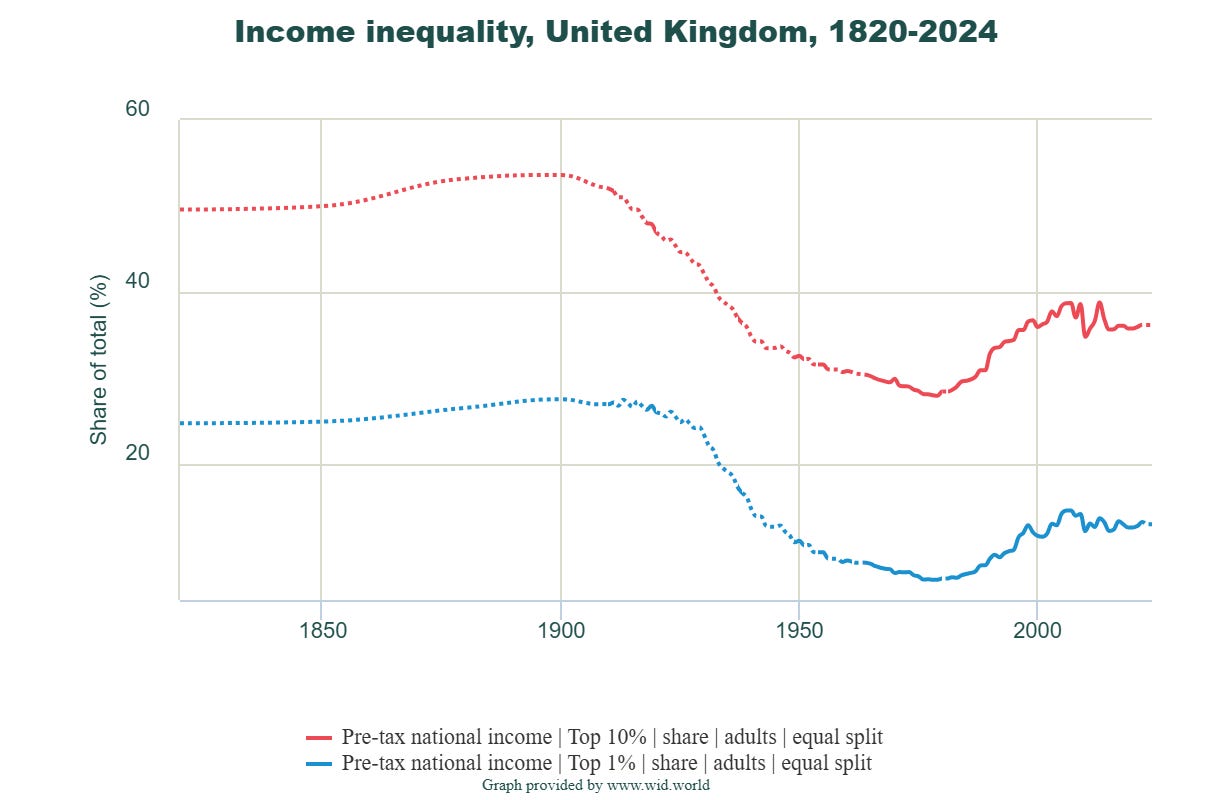
Zero sum claims about economic robbery are false. (Even if inequality were rising—they would still be false.) And the resulting redistribution is equally misguided. Gary’s proposed wealth tax is a litany of errors both economic and moral. This is seen in the documentary, in conversation with tax expert Dan Neidle, who pulls zero punches in summarising the proposal as “populist claptrap.” The numerical concerns are broadly twofold: systems inertia and insufficient funds. First: the scale of such a proposal would take years to devise let alone implement. As Neidle states:
“It would require—let’s be generous—about a year of planning, at least. You then need to build the systems you need to tax 20,000 people. You are not going to raise any revenue from a wealth tax before 2029. You can be in favour of a wealth tax; but anyone claiming that it’s an answer is deluded.”
And, second, the revenue estimation is simply too low. On Gary’s own website he estimates the tax scheme could raise £22–£24 billion annually. That is without a doubt a generous appraisal, making no adjustments for legal evasion or capital flight. But even as it stands: it is nothing. Annual yearly spending in the UK straddles £1.2 trillion; our monthly borrowing in June alone was £16 billion and our government debt interest was a further £11.8 billion.
But this is all accounting. The real indictment, I maintain, lies within the psychology and expression of Gary’s objective. It does not matter that his plan is misleading and untenable; he gestures convincingly that merely to gesture about poverty and hardship is enough to relieve it. Even his recent retirement, announced just last week, is an enactment of his premise that submission—properly marketed—is a legitimate form of policy strategy. “Long story short is: I’m knackered.” He exhales with melancholy in his farewell address. It certainly appears that, in the 21st century, even our martyrs are dismal.
Follow me on Twitter/X @tomhyde_