
The Hierarchy Fall
On scale, our place in the cosmos, and the greatest photo ever taken.

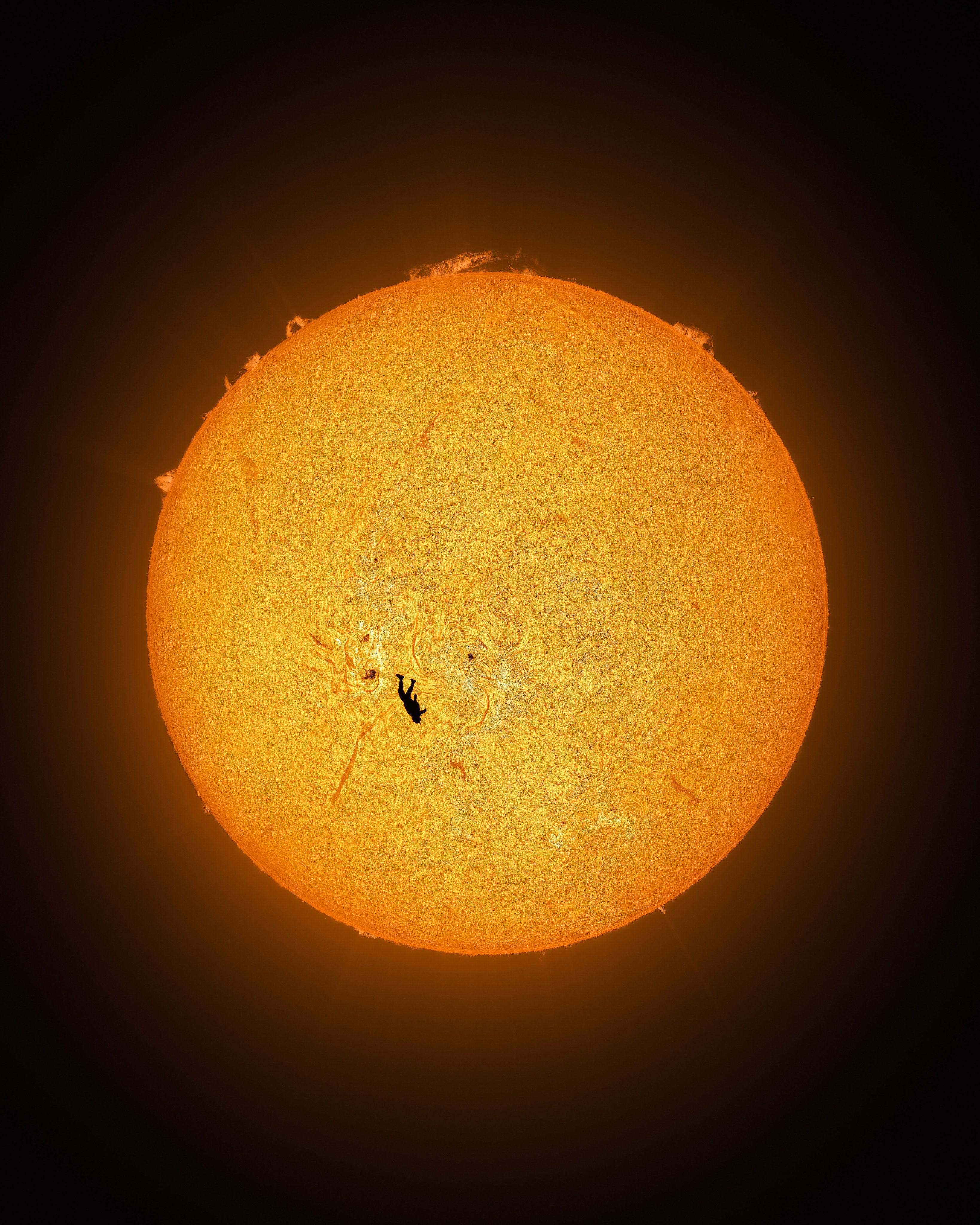
“Is not a man’s walking, in truth, always that: ‘a succession of falls’?”
— Thomas Carlyle
The hierarchy rule, writes David Deutsch, is false. Small things can influence large things. Units of DNA, for example, have transformed the Earth from a sterile promontory into the fertile ecosystem we inhabit today. As Deutsch explains:
“In our biosphere, molecule-sized objects, genes, control vastly disproportionate resources. The first genes for photosynthesis, by causing their own proliferation, and then transforming the surface of the planet, have violated or reversed the hierarchy rule by the mind-blowing factor of 10 to the power 40.”
— TED: After billions of years of monotony, the universe is waking up
This is surprising, because, for the first ten billion years of existence, the hierarchy rule was true. Large things ruled. Planets vacuumed asteroids, stars herded planets, black holes swallowed everything. As Deutsch again expands:
“Big, massive, powerful things strongly affect lesser things, and not vice versa. I call that the hierarchy rule. For example, when a comet hits the Sun, the Sun carries on just as before, but the comet is vaporized.”
It is remarkable that a habit of nature could last so long without exception without itself being a descriptive law. But it is much more remarkable that, after so long, it could not merely be violated but outright reversed: here, on Earth—and only on Earth—do small things influence their more sizeable neighbours. Here, on Earth—and only on Earth—do Davids become Goliaths. This is thanks to the singular power of knowledge: useful, causal, replicating information, first encoded in the aforementioned genes, and, sometime later, in the minds of creative agents we call people. In us.
One of those people, Andrew McCarthy, uses hydrogen-alpha telescopes to photograph the Sun’s chromosphere. Earlier this year, in September, he captured a Falcon 9 rocket launch transiting our star.
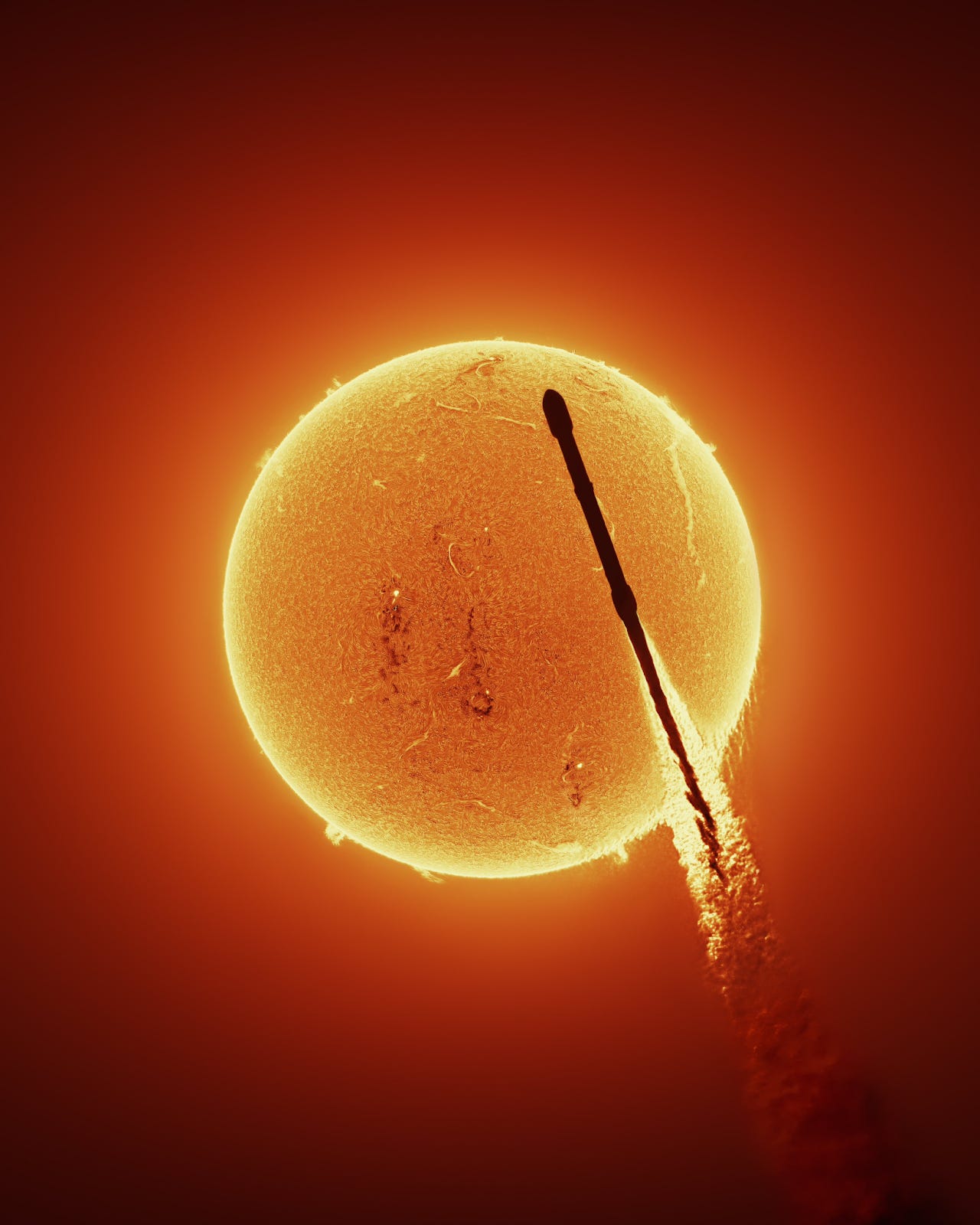
This photograph—captured through a narrowband solar filter and composed from over 100,000 individual exposures—practically writes its own ekphrasis. The Sun, Sol, our sole source of life bringing light, rendered, smoldering, a spherical ember; an orb-molten mote-gem; a plasma patterned damascus; a silver-lined, golden-filled, fire-fretted nimbus. And the Falcon, the rocket, the arrow eclipse. The drooping plumes obscure an otherwise absolute shadow, a sort of dancing uncertainty that blends perfect silhouette and partial translucence. It is almost as if the act of the ascent ascends us—if only for a moment—aesthetically to a rank alongside heavenly bodies. A consummation. Indeed, another likely metaphor, pointed out in the replies on McCarthy’s X premier of the photo, is that of a sperm and ovum. I think this is fitting. What is adventure, I would agree with those critics, if not romancing the stars?
But it is McCarthy’s second viral chromosphere photograph, the dramatically titled “The Fall of Icarus”, that links back to Deutsch’s hierarchies and speaks most meaningfully to our cosmic position. Here is a close-up of the work.
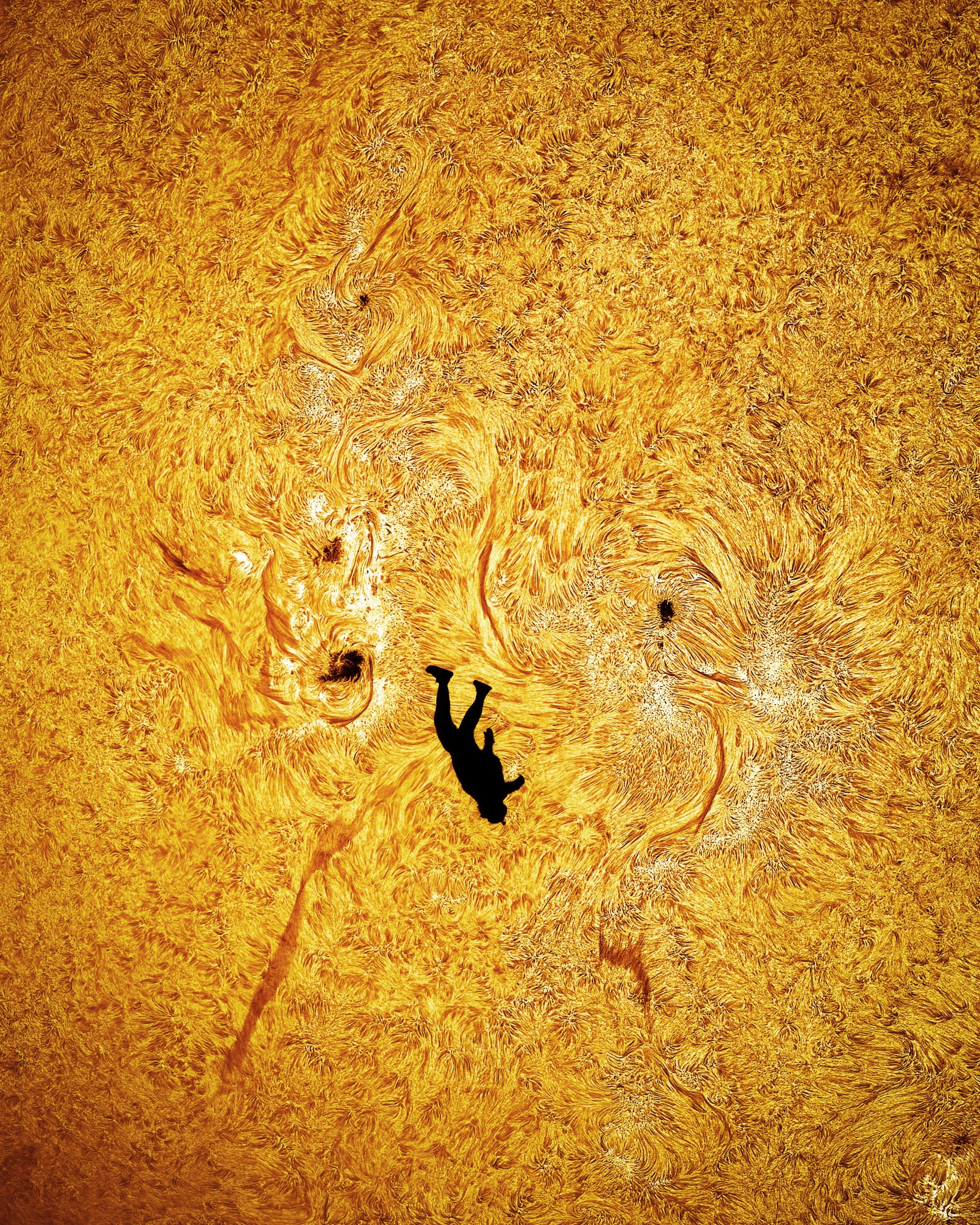
The rocket, ascending, is replaced by McCarthy’s friend, Gabriel C. Brown, moments after leaping from a paramotor. You might lament the change in direction. I do not. As SpaceX again have shown us with its multiple rocket catches: falling, too, can inspire. It should rank alongside the most superlative optimism that the laws of nature not merely afford for supermassive controlled descent but demand that aurora are sparked in its process; that the good in this universe allies with the beautiful; that falling meets hands; that fire shapes light.
All these themes are present in The Fall of Icarus. The intricate texture of the Sun’s outermost surface appears to dissect, reacting less to Icarus than to Moses, with filaments and prominences apparently lensing around a superior gravity. Brown himself is a paradox of resting motion. I am reminded of the journalist Tom Junod, in his editorial following 9/11, about the lone “Falling Man” captured in an eerily similar, placid repose:
“If he were not falling, he might very well be flying. He appears relaxed, hurtling through the air. He appears comfortable in the grip of unimaginable motion. He does not appear intimidated by gravity’s divine suction or by what awaits him. His arms are by his side, only slightly outriggered. His left leg is bent at the knee, almost casually.”
— Tom Junod, Esquire, 2003
That fall—and that prose—was beauty braving sorrow. The same cannot be said for Brown’s, a purely triumphant work. The second only connecting factor are the dimensions:
“In all the other pictures, the people who did what he did—who jumped—appear to be struggling against horrific discrepancies of scale.”
The hierarchy rule returns. Indeed, “horrific discrepancies of scale” is an appropriate summary of a cosmological tyranny epitomised by magnitude. And indeed, as we began, no more. Junod’s falling man is a subject seven million times smaller than his backdrop. McCarthy’s is one four sextellion times smaller than that. But both men dominate the artworks with a tantalising forced perspective. As McCarthy explains in the replies to his own work, if Brown were an equal distance from the camera as the Sun he would measure 100,000km—or eight Earth’s diameters—tall. If he fell across the entire star’s distance in the mere half-second witnessed he would clock well over nine times the speed of light.
All these images serve to ratify Deutsch’s subversion. The hierarchy rule is false. And, as he goes on to conclude:
“[People are] potentially far more powerful [than genes] because of universality. When human knowledge has achieved a factor 10 to the 40, it will pretty much control the entire galaxy, and will be looking beyond.”
Small things can rise—or indeed fall—to the consequence of objects many magnitudes greater than their own. McCarthy’s photography manifests this principle with just two characters. One is a giant—of celestial area—whose outshining brilliance conceals a far more manifold fire; whose overmastering command extends to all bodies tracing its orbits; and whose propagating magic might yet spell superior wonders for millennia to come.
The other is the Sun.
Follow me on twitter/X @tomhyde_
"Here, on Earth—and only on Earth—do Davids become Goliaths." Solid. This Letter may well be your best one yet, Tom.
We will have powers gods can only dream about.